Choosing among China’s top uniform manufacturers takes more than comparing prices or polished product photos. In Uniform Manufacturing, dependable results come from fabric selection, consistent sizing, strong stitching, and reliable production planning. A jacket may look sharp on a sample rack, yet its seams can loosen after repeated washing. Details matter. So does proof.
Manufacturing quality expert W. Edwards Deming is widely associated with the principle, “Quality is everyone’s responsibility.” That idea applies to uniforms, where designers, fabric suppliers, factory teams, and quality inspectors all affect the finished garment. A useful comparison should examine each company’s product range, customization options, minimum order quantities, sample process, and ability to meet delivery schedules. Ask how fabric performance is tested, and whether the factory can maintain consistent measurements across a large order. A low quote alone answers little.
This guide introduces prominent Chinese uniform manufacturers and the strengths buyers may want to investigate, from workwear and hospitality apparel to school and corporate uniforms. “Top” is not a fixed ranking; the best fit depends on garment type, order volume, budget, and service expectations. Public company descriptions can also leave gaps. Verify specifications, request samples, and confirm production details before making a decision. A comparison helps, but it cannot replace careful checks.
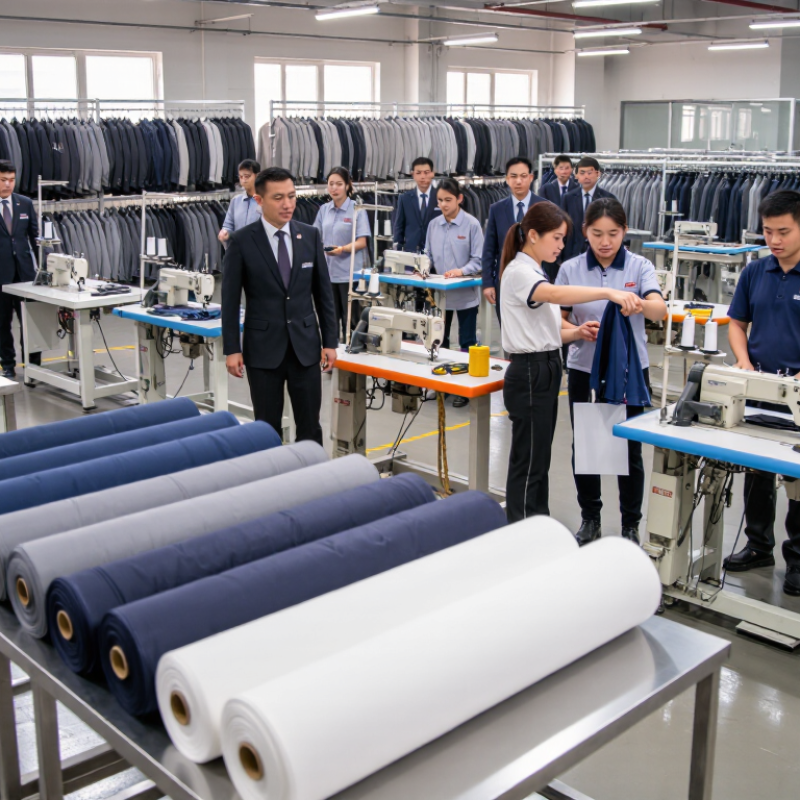
A top uniform manufacturer in China is not simply the one with the lowest quote or largest factory. It should turn a clear brief into garments that fit, perform, and stay consistent across repeat orders. Ask how it checks measurements, fabric weight, colorfastness, stitching, and shrinkage. These details matter when staff wash uniforms every week or work long shifts in warm conditions.
Request samples made with the proposed fabric and construction, not just a polished showroom piece. Check seam strength, pocket placement, zipper movement, and whether the garment remains comfortable when worn and washed. A useful supplier can explain production steps, sample revisions, inspection points, and realistic lead times. Ask to see the process. Clear answers are more useful than broad promises.
Communication is part of manufacturing quality. A capable team should flag unclear sizing, explain material trade-offs, and report delays before they affect delivery. Confirm who approves the final sample and how defects are handled. No checklist catches everything. Even experienced buyers can miss a small fit issue until workers wear the garments through a full shift, so wearer feedback should inform the next production run.
Chinese uniform manufacturers vary widely in product focus, scale, and customization. A useful company profile should check fabric sourcing, sample-development capacity, production controls, and experience with repeat orders—not just catalog size. China’s National Bureau of Statistics reported apparel output of about 24.4 billion pieces in 2023. That scale signals deep manufacturing capacity, but it does not prove that any supplier can meet a particular uniform specification.
A coastal manufacturer profile may emphasize export coordination, pattern development, and access to textile mills. An inland factory may compete through larger production runs or lower operating costs. Specialist workshops often handle workwear, healthcare garments, or school uniforms, where pocket placement, reinforced seams, and wash durability matter. Ask for material specifications, inspection records, and a pre-production sample. Small details count.
The China National Textile and Apparel Council reported textile and apparel exports of approximately US$293.6 billion in 2023, illustrating the sector’s international reach. Still, export scale is not a substitute for supplier-level evidence. A careful profile should distinguish owned production from subcontracting and describe how defects are tracked. A profile can miss the mark. Even a polished sample may not reflect bulk production, so buyers should verify capacity and quality checks against their own order requirements.
Uniform categories reveal more than a manufacturer’s product range. They show which fabrics, sizing systems, and production details a supplier must handle. China’s major uniform makers commonly serve corporate offices, hotels, hospitals, schools, factories, and logistics teams. A Grand View Research estimate valued the global workwear market at about US$17.6 billion in 2023. This is a broad workwear figure, not a measure of China’s uniform production.
Corporate and hospitality uniforms often prioritize consistent colors, easy-care fabrics, and repeat ordering. Healthcare ranges may include tunics, scrub sets, and lab coats, with practical pockets and fabrics suited to frequent washing. Industrial and logistics clothing can include high-visibility garments, durable jackets, and work trousers. School uniforms and outdoor teamwear form other common categories. Not every order fits. A catalogue may look comprehensive, but actual fabric choices, sample quality, and size grading can vary by factory. That distinction is easy to miss.
Tips: Match the category to the work environment, then ask for fabric specifications and a pre-production sample. Check seam strength, pocket placement, and color under daylight. Small details matter. A sample can still differ from bulk production, so confirm the approved specifications in writing.
These categories are commonly available from manufacturers in China. The bars indicate category presence, not market share, production volume, or a ranking; product ranges vary by manufacturer.
Manufacturing Capabilities, Quality Standards, and Export Markets
China’s leading uniform manufacturers stand out through reliable production, not factory size alone. Grand View Research’s Workwear Market report valued the global market at USD 17.8 billion in 2023 and projected 4.3% annual growth through 2030. That demand rewards suppliers able to manage fabric sourcing, sampling, bulk production, and repeat orders. Strong factories can show how they control each step. A large catalog is not proof of consistent quality.
Look for documented checks on colorfastness, shrinkage, seam strength, and fabric weight. ISO 9001 certification can indicate a quality-management system, but buyers should verify its scope and review recent product test reports. Export experience also matters: packaging, labeling, lead times, and documentation must match destination-market requirements. North American and European buyers may set different specifications, so one standard sample will not suit every order. Audits can help, though even a polished audit may miss inconsistent work on a busy production line.
Tips: Request a pre-production sample, then compare it with goods from the first bulk run. Ask for dated test results and a clear defect-handling process. Small checks prevent costly surprises.
A strong Chinese uniform manufacturer is not simply the one offering the lowest quote. Compare suppliers using the same written specification: fabric composition, weight, color tolerance, seam strength, shrinkage, and size grading. Ask for a production sample, then wash it using your intended care process. Check whether the collar twists, seams pucker, or colors fade. Small details matter.
Material claims deserve scrutiny. Textile Exchange’s Materials Market Report 2024 estimates that global fiber production reached 124 million tonnes in 2023, with polyester accounting for about 57% of output. This scale makes fiber traceability and consistent fabric sourcing useful questions—not proof of a supplier’s quality. Request fabric test reports, clarify who conducts testing, and confirm that bulk fabric matches the approved sample. A sample can still mislead.
Compare lead times, minimum order quantities, defect handling, and communication in a trial order. Ask for dated records of on-time delivery and inspection results, rather than relying on verbal promises. Verify whether the factory or a subcontractor performs cutting, sewing, and finishing. A scorecard helps, but it cannot reveal every production problem. I would leave room for a small pilot run and revise the specifications after seeing how uniforms perform during real shifts.
Check fabric sourcing, sample development, production controls, and repeat-order experience. A large catalog proves little.
Send each supplier the same specifications for fabric weight, color tolerance, seam strength, shrinkage, and sizing. Details matter.
Wash it using your intended care process. Look for twisted collars, puckered seams, fading, and changes in fit.
No. China’s apparel output reached about 24.4 billion pieces in 2023, but sector scale does not verify one factory’s quality.
Request fabric test reports and ask who conducted the tests. Confirm bulk fabric matches the approved sample. Samples can mislead.
Yes. Clarify who handles cutting, sewing, and finishing. A polished sample may not show how bulk orders are made.
Ask for dated delivery records, inspection results, and details about defect handling. Verbal promises are hard to measure.
It helps compare lead times, minimum order quantities, and quality checks. I would still leave room for a pilot run. Real shifts can reveal problems the scorecard missed.
This article explains what makes a uniform manufacturer stand out in China, including reliable production, consistent quality, clear communication, and the ability to meet different business requirements. It outlines the kinds of companies buyers may encounter and describes common uniform categories, such as workwear, hospitality apparel, healthcare garments, school uniforms, and corporate clothing. Rather than focusing on brand names, the overview highlights the qualities and services that help manufacturers serve a range of industries.
It also considers manufacturing capabilities, quality-control practices, customization options, and experience supplying international markets. Readers will learn how to compare potential suppliers by reviewing product samples, production capacity, material choices, lead times, and service standards. By understanding these factors, buyers can make a more informed decision and identify a partner whose Uniform Manufacturing capabilities align with their needs, budget, and expectations.