Finding the best custom denim jeans manufacturer requires more than comparing factory prices. Custom Denim Jeans Manufacturing combines fabric engineering, pattern development, washing control, quality assurance, and responsible sourcing. A strong partner should explain each stage clearly, from 12-ounce denim selection to shrinkage testing and pocket reinforcement. The details matter. A poorly balanced waistband can ruin an otherwise excellent pair.
Industry data shows why material decisions deserve careful attention. Textile Exchange’s Materials Market Report 2024 estimated global fiber production at 124 million tonnes in 2023, with cotton representing approximately 22%. This scale highlights cotton’s importance, but it also exposes supply-chain pressures. Buyers should request fiber origin records, recycled-content documentation, and recognized certifications when relevant. The report also warns that broader material growth does not automatically mean better environmental performance. A label alone proves little.
Reliable manufacturers provide measurable evidence. Ask for pre-production samples, fabric test reports, colorfastness results, and a written inspection standard. Check their minimum order quantity, lead times, sewing capacity, and repair procedures. The Sustainable Apparel Coalition’s Higg Facility Environmental Module can support factory comparisons, although its results should not replace independent verification. That limitation matters.
Do not choose the cheapest quote too quickly. It may exclude washing tests, packaging, or defect allowances. A factory may also promise everything during sampling, then struggle during bulk production. That uncomfortable gap deserves attention. Visit the facility when possible, or arrange a third-party audit. Examine stitching density, machines, worker safety controls, and finished garments under natural light. The best partner is not always the largest. It is the manufacturer that communicates accurately, documents consistently, and improves when problems appear.
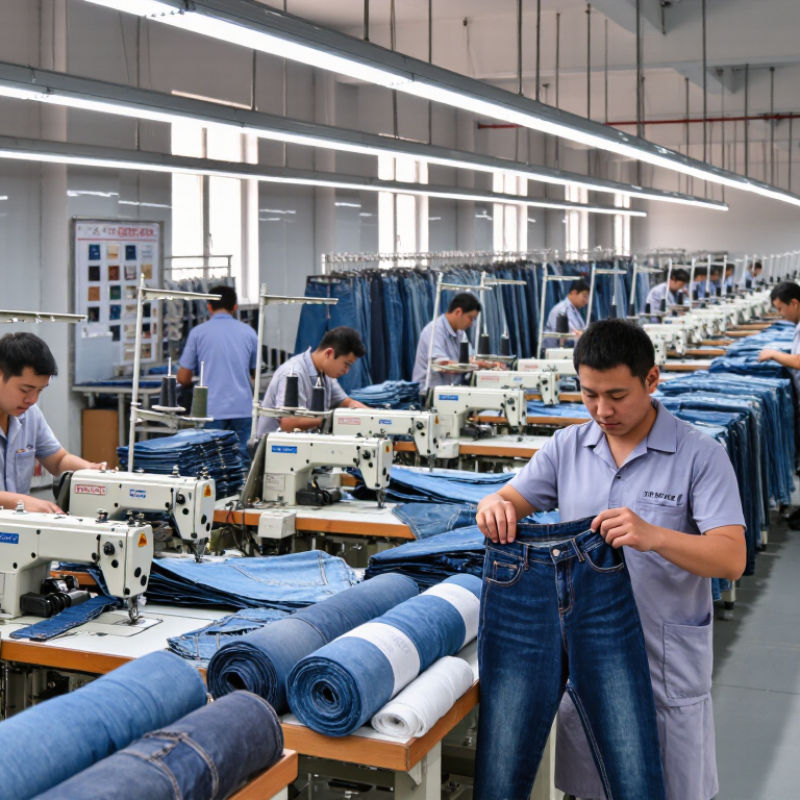
Before comparing manufacturers, turn your denim idea into measurable product requirements. State the target customer, size range, fit block, fabric weight, stretch percentage, color, wash effect, hardware, stitching, and packaging. A phrase like “premium vintage jeans” is too vague. Specify a 12-ounce rigid cotton fabric, high-rise straight fit, antique silver buttons, and a light enzyme wash.
Material choices need evidence. Textile Exchange’s Materials Market Report 2024 states that cotton represented about 22% of global fiber production in 2023. Ask suppliers for fiber composition, origin records, and applicable certifications. If recycled or preferred cotton is required, define the accepted standard before sampling. This prevents attractive claims from replacing verifiable documentation.
Fit tolerances should be written in centimeters, not opinions. Include waist, hip, thigh, inseam, leg opening, shrinkage allowance, and grading rules. Request a measurement chart and a physical sample after washing. Manufacturing experience shows that wash development can change hand feel and dimensions significantly. Test colorfastness, seam strength, crocking, and metal safety through an independent laboratory when appropriate. ASTM and ISO testing methods can support consistent evaluation.
Keep the brief practical.
Include order quantity, target cost, delivery window, sample rounds, and acceptable defect limits. A common mistake is approving a beautiful sample without calculating production loss or alteration costs. I would also challenge my own assumptions: a heavier fabric may look durable, yet it can reduce comfort and slow sewing. Clear requirements help a manufacturer quote accurately, identify risks, and demonstrate dependable technical control.
Finding the best custom denim jeans manufacturer requires careful research, not attractive factory photos. Build a shortlist using production experience, fabric knowledge, and verified customer feedback. Check whether each factory has made similar fits, washes, and fabric weights before requesting prices.
Ask for a detailed quotation covering minimum order quantities, sampling fees, grading, packaging, and delivery schedules. Request fabric swatches and physical samples, not only digital images. Inspect waistband tension, zipper strength, pocket alignment, seam density, and shrinkage after washing. Samples expose weaknesses. Compare each result against the same technical specification.
A factory audit, whether in person or through an independent service, can reveal useful details. Review quality-control records, worker training, equipment maintenance, and production capacity. Confirm relevant environmental and workplace documentation without accepting vague promises. Contact two or three previous customers when possible, and ask about late deliveries or repeated defects. My own early comparison focused too heavily on unit price, which caused costly corrections later. That mistake still matters. Numbers can mislead. Reliable communication matters just as much as competitive pricing. Track response times, revision accuracy, and how clearly the manufacturer handles an imperfect sample. A supplier that explains problems honestly may be safer than one offering flawless claims.
Choosing a custom denim jeans manufacturer starts with evidence, not polished promises. Ask for fabric swatches, seam samples, and a production reference you can verify. In my factory assessments, uneven topstitching often reveals rushed machine settings. Check the waistband, pocket corners, belt loops, and button attachments by hand. Small details matter. A reliable factory should explain fabric weight, shrinkage, colorfastness, and washing limits clearly. If answers remain vague, treat that as a warning sign.
Production skills become visible during sampling. Request a graded size set, not one perfect sample. Measure the rise, thigh, inseam, and leg opening after washing. Compare these measurements with the approved specification. Skilled technicians record tolerances and correct pattern problems before bulk cutting. Ask how they control cutting direction, panel matching, and shade variation. Denim can look consistent on a roll yet differ after washing. That surprised me early in product development. I once trusted a beautiful sample too quickly.
Customization should cover more than labels and thread colors. Discuss fabric composition, stretch recovery, fits, pocket shapes, hardware, embroidery, washes, and repair effects. The manufacturer should provide a clear sampling timeline and inspection checkpoints. Confirm whether washing is handled in-house or by a qualified partner. Request test reports when performance matters. Keep approved measurements and color standards in writing. Production pressure can change details. A final pre-shipment inspection helps, but it cannot replace careful sampling. Leave room for correction. Good cooperation includes honest disagreement when a requested finish may weaken the fabric or distort the fit.
| Evaluation Dimension | Practical Benchmark or Requirement | What to Ask the Manufacturer | Recommended Verification Method |
|---|---|---|---|
| Denim Fabric Weight | Common jeans fabrics range from approximately 8 to 16 oz per square yard. Lightweight denim is generally more comfortable, while heavier denim offers a structured appearance and greater abrasion resistance. |
|
Request a fabric swatch and confirm weight through a third-party or internal textile laboratory. Check fiber content, weave, stretch recovery, and hand feel against the approved sample. |
| Fiber Composition | 100% cotton is commonly used for rigid denim. Stretch denim often contains a small percentage of elastane, frequently around 1% to 3%, depending on the required fit and recovery. | Can the factory source organic cotton, recycled fibers, cotton-elastane blends, or other specified materials? | Compare the supplier's composition declaration with laboratory fiber-content testing and the final garment specification sheet. |
| Colorfastness | A dependable production program should define wash, rubbing, perspiration, and light colorfastness requirements before bulk production. Dark indigo may transfer more color during early wear and washing. | Which colorfastness standards and test methods do you use? Can you submit test results for dry and wet rubbing? | Approve a lab dip or garment wash standard, then conduct pre-production and random bulk tests against the agreed acceptance level. |
| Shrinkage and Dimensional Stability | Denim can shrink during washing, especially when it is not sanforized or has not received a controlled pre-shrink treatment. The acceptable tolerance should be stated separately for length and width. | Is the fabric sanforized or pre-shrunk? What shrinkage results are typical after the specified wash process? | Measure approved panels before and after the intended wash cycle. Use the results to finalize pattern measurements and grading rules. |
| Pattern Making and Fit Development | A skilled manufacturer should be able to develop blocks for different rises, leg shapes, body proportions, and size ranges. Fit approval should be completed before bulk cutting. | Do you provide pattern development, grading, and technical-pack review? How many fit samples are included in the development process? | Submit a complete tech pack and evaluate the first sample, corrected sample, and pre-production sample using a measurement specification and fit comments. |
| Stitching and Seam Construction | Seam type, stitch density, thread selection, and reinforcement should match the stress points of jeans. Belt loops, pocket corners, fly areas, and crotch seams commonly require additional reinforcement. | Which machines and stitch types are used for inseams, outseams, pocket bags, belt loops, and waistband attachment? | Inspect seam allowance, skipped stitches, open seams, puckering, back-tacking, bartacks, and thread consistency on samples and random finished garments. |
| Hardware and Trims | Rivets, buttons, zippers, labels, patches, and pocketing should be compatible with the garment design and wash process. Hardware must be securely attached and free from sharp edges. | Can you customize hardware finishes, logo placement, label materials, and packaging? Are nickel-release and restricted-substance requirements supported? | Approve a complete trim card and test hardware after washing. Check attachment strength, corrosion resistance, sharp edges, and color consistency. |
| Wash and Finishing Skills | Available techniques may include rinse wash, stone wash, enzyme wash, bleach effects, tinting, whiskering, hand scraping, laser effects, and ozone treatment. Each process changes color, softness, surface appearance, and measurements. | Which wash effects can be reproduced consistently? Can you control abrasion placement, shade variation, and wash-to-wash repeatability? | Approve a physical wash standard with front, back, pocket, and detail views. Compare bulk garments under consistent lighting and measurement conditions. |
| Customization Capability | A capable partner should support custom fit, fabric, color, wash, stitching, pocket shape, hardware, labels, embroidery, patches, and packaging. | Which elements can be customized without changing the production process? What are the extra costs, minimum quantities, and development requirements for each option? | Request a written customization matrix showing available options, sample charges, tooling fees, minimum order quantities, and expected lead times. |
| Minimum Order Quantity | Minimum quantities vary by fabric, color, wash, hardware, and production line. Lower quantities may be possible for sampling or small-batch programs but can increase the unit cost. | What are the minimum quantities per style, color, fabric, and wash? Can quantities be combined across sizes or colors? | Obtain a quotation that clearly separates style, color, size, fabric, wash, and trim minimums. Confirm all assumptions in the purchase agreement. |
| Sampling and Production Timeline | The timeline depends on design complexity, fabric availability, sample revisions, washing, and order quantity. A written critical-path schedule is more reliable than a general delivery promise. | How long do pattern development, fabric approval, fit samples, pre-production samples, and bulk production take? | Request milestone dates and production status updates. Do not start bulk production until fabric, fit, wash, trims, and measurement approvals are documented. |
| Quality Control System | A structured system should include incoming-material inspection, in-line inspection, end-line inspection, measurement checks, and final random inspection. | Do you use an AQL-based final inspection or another documented sampling plan? Can you provide inspection records and corrective-action reports? | Review the quality manual, inspection checklist, defect classification, measurement tolerance, and sample inspection report. Arrange an independent pre-shipment inspection when appropriate. |
| Social and Environmental Compliance | Responsible sourcing should address labor conditions, workplace safety, chemical management, wastewater control, and traceability. Requirements should match the destination market and buyer code of conduct. | Which social, environmental, chemical, and product-safety audits or certifications can you support? How are wastewater and chemical records maintained? | Verify current audit documents directly with the issuing organization where possible. Review corrective actions rather than relying only on a certificate or self-declaration. |
| Communication and Documentation | Clear communication reduces errors in measurements, materials, wash effects, labeling, packaging, and shipment requirements. All approvals should be traceable. | Who is responsible for technical communication, approvals, quality issues, and production updates? Which documents are included with each order? | Evaluate response time and accuracy during sampling. Require an approved tech pack, bill of materials, measurement chart, color standard, wash standard, and packing specification. |
| Cost Transparency | The total cost may include fabric, cutting, sewing, washing, trims, labels, packaging, sampling, testing, tooling, freight, and applicable duties. | Does the quotation itemize development fees, sample costs, wash charges, packaging, testing, and payment terms? | Compare quotations using the same specifications. Request written confirmation of what is included, excluded, changeable, or subject to material-price fluctuations. |
| Recommended Decision Rule |
Quality first Select the manufacturer that consistently meets the approved specifications, not simply the supplier offering the lowest initial price. |
Can the manufacturer demonstrate repeatability across samples, pilot production, and bulk orders? | Use a weighted scorecard covering fabric quality, fit, sewing, wash consistency, customization, compliance, communication, lead time, and total cost. Approve a small pilot order before committing to a large production run. |
A reliable denim manufacturer should provide clear certification records before discussing large orders. Ask for certificates covering quality systems, environmental practices, and workplace safety. Check the issuing body, expiry date, factory address, and approved production scope. A copied document is not proof. Request a recent audit report or verification link when possible. Speaking with two previous clients can also reveal whether factory claims match daily performance.
Costs need careful inspection. Request a detailed quotation for fabric weight, denim composition, washing, trims, labels, packaging, sampling, and shipping. A low unit price may hide expensive development fees or weak fabric quality. Ask how price changes with different quantities. Confirm payment stages in writing. Protect your budget with a pre-production sample, even when the sample fee feels inconvenient.
Minimum order quantities should match your sales forecast, not the factory’s preferred volume. Ask whether color, size, and fabric requirements have separate minimums. Lead times must include pattern approval, sample revisions, material purchasing, production, washing, inspection, and delivery. Build in a small buffer. Delays happen. A written production calendar is more useful than a confident promise. One practical mistake is trusting an attractive deadline before confirming fabric availability. Recheck it. Suppliers should explain risks early, communicate consistently, and provide measurable updates throughout production.
Requesting samples is the most practical way to evaluate a custom denim jeans manufacturer. Photos cannot reveal uneven stitching, harsh hand feel, or inaccurate measurements. Textile Exchange’s Materials Market Report 2024 estimates global fiber production reached 124 million tonnes in 2023. Cotton represented roughly one-fifth of that volume, making material traceability important for denim development.
Ask for a pre-production sample using your exact fabric weight, weave, hardware, labels, and wash instructions. Measure the waistband, rise, inseam, thigh, and leg opening after washing. Check shrinkage, seam strength, colorfastness, and pocket alignment. ISO 105-C06 can support colorfastness testing, while ISO 6330 provides laundering procedures. A sample is evidence, not decoration. One overlooked detail can affect thousands of pairs.
Tips: Send a clear tech pack with tolerances, not only reference images. Request two samples: one unwashed and one laundered. Photograph both beside a measuring tape. Ask the factory to explain rejected pieces and corrective actions. A reliable partner should disclose fabric composition, minimum order quantities, sample fees, lead times, and inspection procedures. The Better Cotton Principles and Criteria also emphasize responsible production practices, but certification claims still require verification. Be careful here. Even experienced buyers may trust polished paperwork too quickly. Compare sample quality with communication speed, technical questions, and willingness to revise details. Choose the manufacturer that proves consistency, not merely promises it.
Specify the customer, size range, fit, fabric weight, stretch, color, wash, hardware, stitching, and packaging. A 12-ounce rigid cotton fabric is clearer than “premium vintage jeans.”
Ask for fiber composition, origin records, and relevant certification documents. Attractive claims are not enough. Evidence protects your product decisions.
Use centimeters, not opinions. Include waist, hip, thigh, inseam, leg opening, shrinkage allowance, and grading rules. Request a washed physical sample.
Consider colorfastness, seam strength, rubbing transfer, and metal safety tests. An independent laboratory can provide more objective results. Testing may reveal problems hidden by appearance.
Inspect the waistband, pocket corners, belt loops, button attachments, and topstitching by hand. Uneven stitches may indicate rushed machine settings. Small details matter.
Request a graded size set and measure every size after washing. Compare the rise, thigh, inseam, and leg opening with approved specifications. One sample can hide grading problems.
Discuss fabric composition, stretch recovery, fit, pockets, hardware, embroidery, washes, and repair effects. Customization should involve construction, not only decorative details.
Confirm order quantity, target cost, delivery window, sample rounds, and defect limits. Keep measurements and color standards in writing. A final inspection helps, but it cannot replace careful sampling.
Not necessarily. Heavier fabric may feel durable but reduce comfort and slow sewing. I would question that assumption before approving it.
Ask for an honest technical review and a revised sample. A wash can change dimensions and hand feel. Correction is better than silent compromise.
Finding the right partner for Custom Denim Jeans Manufacturing starts with clearly defining your product requirements, including fabric composition, weight, stretch, washes, fits, sizes, trims, and branding details. With these specifications in place, research and compare potential manufacturers based on their experience, production capacity, communication, and ability to handle your design expectations. Examine their quality control procedures, technical skills, equipment, and range of customization options to ensure they can consistently produce the desired results.
Before making a decision, verify relevant certifications, pricing structures, minimum order quantities, payment terms, and estimated lead times. Request samples or prototypes to evaluate fabric quality, stitching, fit, color accuracy, and finishing details. Compare the samples and overall service carefully, then choose the manufacturing partner that offers the best balance of quality, reliability, flexibility, and cost. A well-planned evaluation process can reduce production risks and support a successful long-term business relationship.